Publications

International and Global Trends
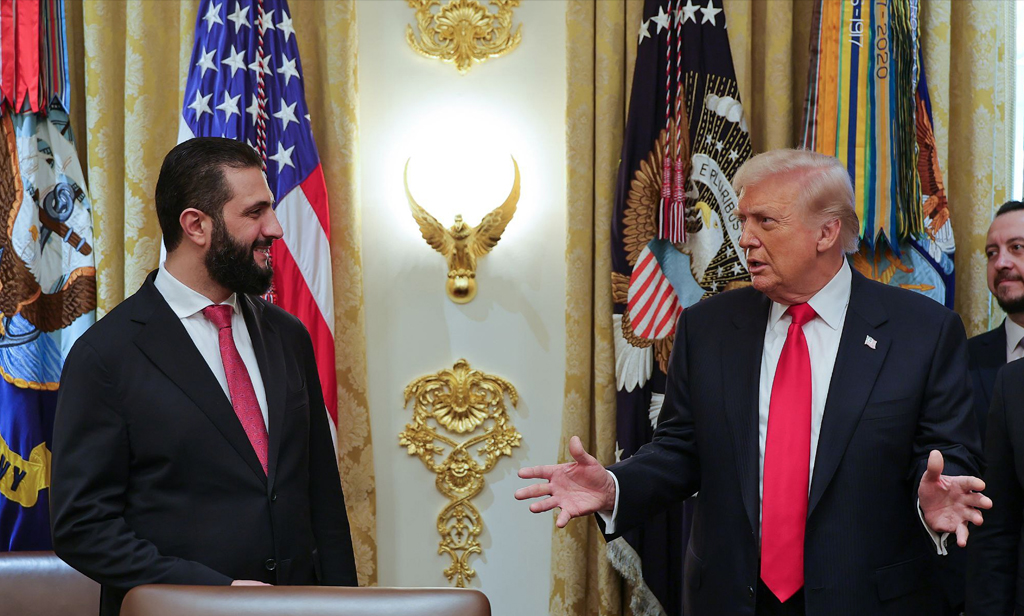
Real clear world: A former terrorist inside the white house
This article examines the unprecedented decision to welcome a former jihadist—long designated as a terrorist by the United States—into the White House. It traces his trajectory from al-Qaeda operative to interim president of Syria, raising urgent questions about a dramatic shift in U.S. foreign policy. The piece challenges readers to consider the consequences of legitimizing a figure whose past is inseparable from decades of extremist violence.

Countering Terrorism and Extremism
Sudan: The Country Hijacked by Islamists and Targeted for Burial by Iran
International and Global Trends
The Gaza War and the Military Deployments in the Region of the World’s Great Powers
The Palestinian–Israeli Conflict
Position Assessment: Potential Pathways of Conflict between Hamas and Israel
Emerging Threats and Non-Traditional Security
Asymmetric Threats:A Study in the Transformations of Traditional Deterrence Strategies
International and Global Trends
The Ukrainian Crisis And Its Repercussions On The Transformation Of Chechen Fighters From "Salafi-Jihadism" To "Sufism Jihadism"
Filter by:

Strengthening Strategic Stability in the Middle East
For the last twenty years, the U.S. played the role of the guarantor of security in the Middle East, however, doubts increase over possible U.S. intent to disengage from the region, and despite signs of the U.S. remaining in the region, there are also solid indications of an intent to partially leave it. Thus, this paper assesses the hypothesis that the U.S. may seek to partially disengage from the Middle East, by proposing a set of strategic options should Washington increase its "partial disengagement" measures.

The Cold War in the Arctic Circle
Following the decline of a large proportion of its ice cover, will the Arctic Ocean become an arena for an arms race between the NATO and Russia? How will the Middle East region be affected by the climate change in the Arctic? This article discusses the strategic importance of the North Pole and answers the previous two questions.

Can Pakistan Be a Regional Counterbalance?
This paper discusses Pakistan’s recent endeavors to position itself as a sovereign state with central importance in balancing the Greater Middle East. This is evident by the country's efforts to combat terrorism and achieve progress in developmental, economic, and military fields in spite of the major challenges, both at the internal and external levels. In its reference to the new Prime Minister Imran Khan, who arose as a popular reformist leader, the paper highlights the principles of his strategy as well as the military aspect of Pakistan. Pakistan’s foreign relations with other regional countries were also examined in addition to the role Pakistan plays in these countries.

Outlook 2019
The 2019 Outlook Report addresses several issues concerning decision-makers in the Middle East and research institutions. It highlights regional and international political, economic, and security foresight for the year 2019 by presenting future scenarios of key and predominant issues of global interest.